Master Promotion Readiness & Executive Presence
Promotion readiness isn’t proven by effort. It’s proven under pressure.
TL;DR:
Promotion readiness isn't proven by what you deliver. It's proven by how you create clarity, trust, ownership, and forward movement when work gets tense or unclear. Managers aren't only asking "did this person deliver." They're asking whether you can make good decisions with incomplete information, influence beyond your team, and steady a room under pressure. The strongest promotion case isn't "I handled the pressure." It's "I helped the room handle the pressure better."
Promotion readiness isn't only proven by what you deliver. It's proven by how you create clarity, trust, ownership, and forward movement when the work gets tense, unclear, or high pressure. At the next level, you're judged by what happens to the room when you're in it.
What is promotion readiness?
Promotion readiness is evidence that you're already operating at the next level. It isn't proven by working harder or taking on more. It shows up as business impact, trusted judgment, bigger scope, clearer decisions, cross-functional influence, steadiness under pressure, and the ability to make work easier for other people.
A promotion isn't only a reward for what you've done. It's a decision about what the business can trust you with next.
Why does promotion readiness show up under pressure?
Promotion readiness is easiest to see when the room gets messy, not when the plan is working and everyone already agrees. It shows up when the timeline slips, the facts are incomplete, priorities conflict, the decision stalls, and the team starts reacting instead of thinking.
Those moments reveal judgment. They show whether you create clarity or add noise. They show whether people trust your presence when the answer isn't obvious. That's why executive presence matters for promotion.
What does executive presence mean at work?
Executive presence is the ability to help people think clearly when the room is under pressure. It isn't polish. It isn't performance. It isn't pretending to be calm.
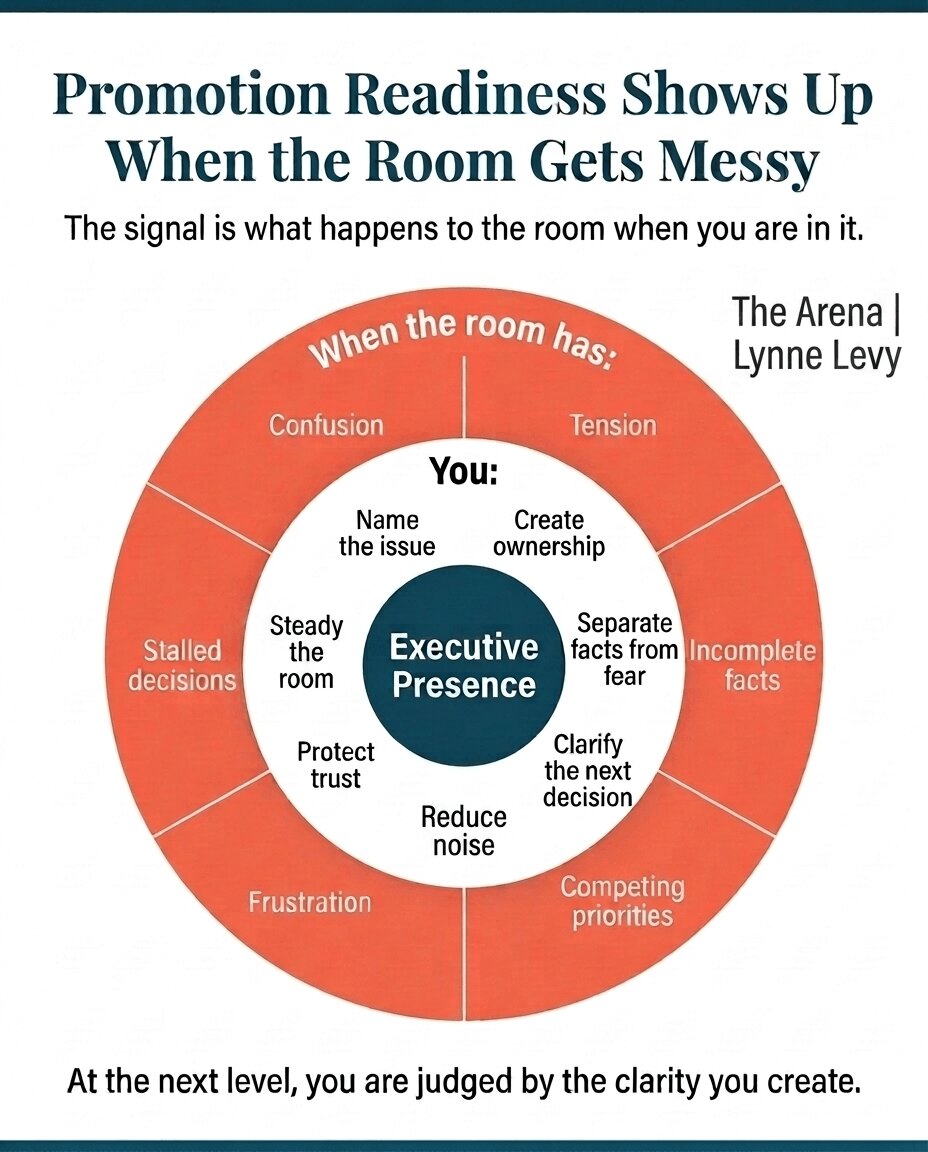
It's what happens when your presence makes the conversation more useful: people get clearer, the real issue gets named, the next decision gets easier, tension becomes productive, trust stays intact, ownership gets clearer. That's a leadership signal, especially for an individual contributor who wants to be promoted.
What mistake do high performers make in promotion conversations?
High performers often build an effort-based case instead of a readiness-based one. Look how much I carried. Look how hard I worked. Look how many fires I put out. Some of that may be true, but effort isn't the same as readiness.
Being overloaded doesn't prove you're ready for more scope. Being the person everyone depends on doesn't always prove leadership. Sometimes it proves the opposite: too much still sits with you, decisions still bottleneck around you, people come to you for answers instead of building their own judgment. That makes you valuable. It doesn't always make you promotable.
The stronger case isn't I handled the pressure. It's I helped the room handle the pressure better.
What does promotion-ready executive presence look like?
When the room gets messy, promotion-ready leaders don't try to prove they're the smartest person in it. They make the room better. Here's what that looks like in practice.
How do you name the real issue?
Messy rooms stay messy when people discuss symptoms instead of the real issue. The missed deadline, the frustrated stakeholder, the unclear ownership: those may be real, but they aren't always the actual problem.
A promotion-ready leader moves the room from noise to truth:
"This sounds like a resource issue, but I think it may actually be a decision issue."
"We're debating the timeline, but the real question is whether the scope still makes sense."
"I think we're treating this like a communication problem, when it may be an ownership problem."
That's a senior move, not because it sounds impressive, but because it saves the room from solving the wrong problem.
How do you separate facts from fear?
Under pressure, people mix what they know with what they're afraid might happen. "The client is going to lose trust." Is that a fact, or a fear? "Leadership won't approve this." Confirmed, or assumed?
Useful questions cut through it: What do we know for sure? What are we assuming? What has actually been said? What's the risk, and what's the evidence? This isn't cold. It's clarity. When the room is anxious, clarity is a service.
How do you clarify the next decision?
Meetings stall when people try to solve everything at once. The project, the people, the politics, the budget, the timeline, the long-term consequences all become one heavy conversation.
Promotion-ready leaders find the decision inside the discussion: What decision do we actually need to make today? Is this a decision, a recommendation, or an update? Who owns the call after this meeting? Not having every answer. Making the next step clearer.
How do you create ownership without carrying everything?
A messy room often has a hidden ownership problem: everyone cares, nobody's clearly accountable. This is where high performers get trapped. They step in, they carry it, they fix it, they become the person who makes the problem go away. That can feel like leadership. If it keeps happening, it becomes a bottleneck.
Creating ownership sounds like: Who is the decision owner? What does this person need from the rest of us? What will each person own by Friday? What should not come back into this room? The goal isn't to carry more. It's to make the system work better.
How do you protect trust under pressure?
Pressure reveals how people spend trust. Some people spend it fast: they blame, they distance themselves, they get sharp. Promotion-ready leaders stay honest without becoming destructive.
You can say "we missed something here and we need to understand why" instead of "this is a mess and someone needs to explain themselves." The difference isn't softness. It's discipline. The more senior you get, the more your emotional discipline affects the room.
How do you reduce noise in a messy room?
A promotion-ready person reduces noise without dismissing complexity. "Let's come back to the decision." "Let's separate what matters now from what matters later." "Let's identify the one thing blocking movement."
Executive presence isn't always loud. Sometimes the most senior person in the room speaks less, but makes the conversation better every time they do.
How do you steady the room?
Steadiness isn't pretending nothing is wrong. It's helping people stay capable while something is wrong. That can look like slowing the pace, asking one clean question, naming the tension without amplifying it, or moving people from reaction to action.
People are often seen as ready for the next level before they have the title because others trust their judgment under pressure. They don't just deliver. They steady.
How do you document promotion readiness?
Document what changed because you were in the room, not only what you completed. Where did you reduce confusion? Move a stalled decision forward? Help senior stakeholders align? Turn tension into a useful conversation? Create ownership instead of becoming the owner of everything?
This evidence often gets missed because it doesn't look like a project milestone. It's leadership.
Examples of the shift from effort language to readiness language:
Instead of: "I helped with a difficult project." Say: "I clarified ownership when the project stalled, which let the team move forward without further escalation."
Instead of: "I handled a tense stakeholder meeting." Say: "I separated facts from assumptions, named the core decision, and helped the group align on the next step."
Instead of: "I was the person everyone came to." Say: "I reduced dependency on me by building clearer ownership and a better decision process."
Instead of: "I worked well under pressure." Say: "I helped the team stay focused, preserve trust, and make a clear decision under pressure."
What do managers look for when promoting someone?
Managers are asking whether you can handle more scope, ambiguity, and consequence, not just whether you delivered. Can you make good decisions with incomplete information? Influence beyond your immediate team? Create clarity without needing constant direction? Handle tension without making the room worse? Build trust with people who don't report to you?
That's why messy rooms matter. They reveal judgment.
Key takeaway
Promotion readiness isn't proven by how much you survived. It's proven by the value, judgment, trust, and clarity you create when the work gets more complex.
Next time the room gets messy, pay attention, n
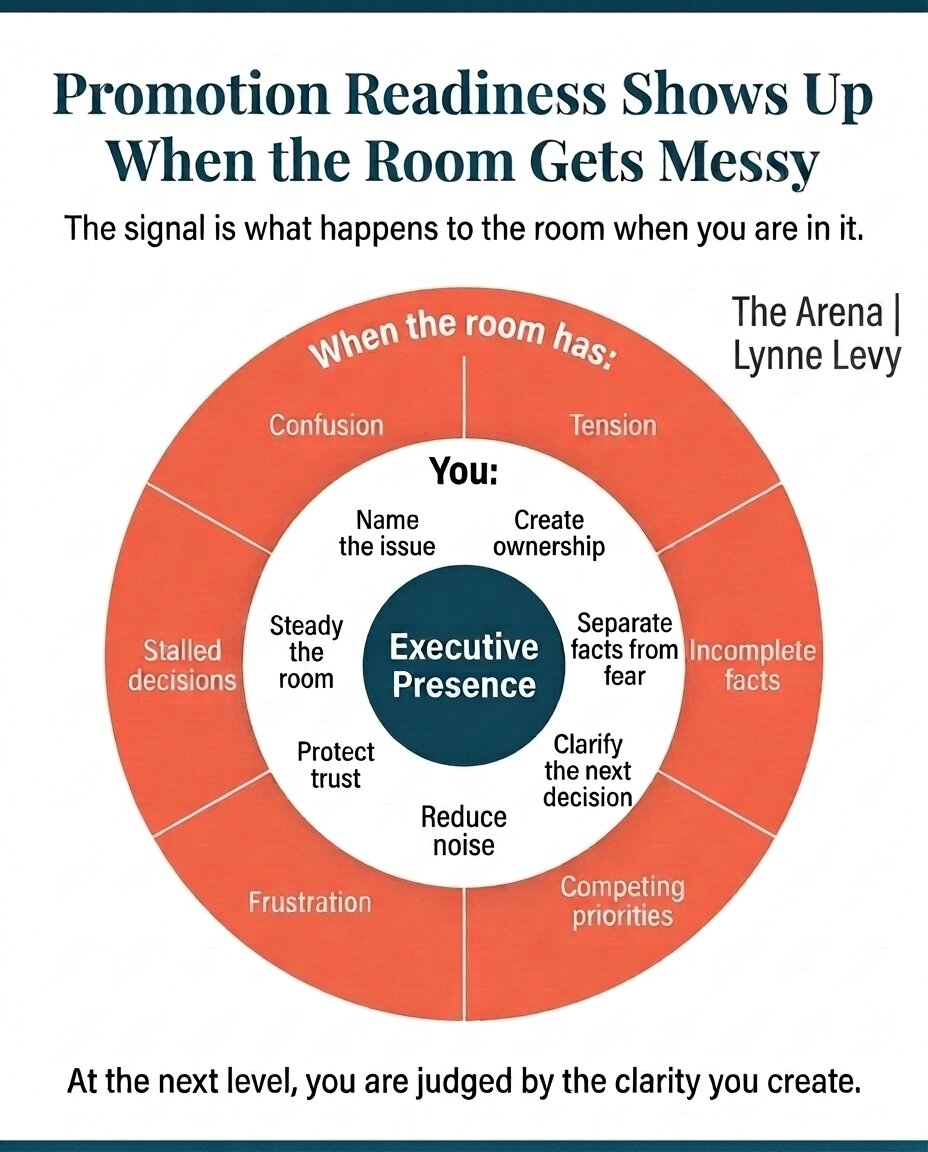
ot just to the problem, but to your effect on the room. Do people get clearer? Does the decision move forward? Does trust stay intact? That's executive presence. At the next level, you're judged by the clarity you create.
FAQ
What does promotion readiness mean? Promotion readiness means you're already showing evidence you can operate at the next level: business impact, trusted judgment, broader influence, stronger decision-making, and the ability to create clarity under pressure.
How do you show you are ready for promotion? Document next-level behavior: decisions you're already making, problems you've made easier for others, trust you've built across teams, and moments your leadership created clarity or progress.
What is executive presence? Executive presence is the ability to create confidence, clarity, and trust in the room. It's not about sounding polished. It's about helping people think clearly and move forward under pressure.
Why is executive presence important for promotion? Senior roles require more than execution. They require judgment, influence, steadiness, and the ability to lead through ambiguity. Leaders notice how you affect the room when things are tense or unclear.
How can an individual contributor show leadership? By creating clarity, asking useful questions, influencing across teams, protecting trust, improving decisions, and helping others move forward. Leadership isn't only about having direct reports. It's about what you make possible for the business.
What should I document for my promotion case? Examples where you created business impact, improved decisions, reduced confusion, created ownership, influenced stakeholders, protected trust, or helped the team move through ambiguity. These are stronger than a list of completed tasks.
What is a common mistake people make when asking for a promotion? Building the case around effort instead of readiness. Effort matters, but promotions are usually based on trust, impact, scope, judgment, and evidence you can succeed at the next level.
What does executive presence look like in a meeting? Naming the real issue, separating facts from fear, clarifying the next decision, creating ownership, protecting trust, reducing noise, and steadying the room when tension rises.
How do you prove leadership before getting promoted? By showing you already create value beyond your current role: making decisions easier, helping others align, increasing trust, reducing confusion, and improving how the work gets done.
If this named something you've been feeling in rooms but couldn't quite point to, hit subscribe. The next one lands in your inbox.
FAQPage schema (paste into GHL custom HTML block, validate at jsonlint.com first)
json
{"@context":"https://schema.org","@type":"FAQPage","mainEntity":[{"@type":"Question","name":"What does promotion readiness mean?","acceptedAnswer":{"@type":"Answer","text":"Promotion readiness means you are already showing evidence that you can operate at the next level. It includes business impact, trusted judgment, broader influence, stronger decision-making, and the ability to create clarity under pressure."}},{"@type":"Question","name":"How do you show you are ready for promotion?","acceptedAnswer":{"@type":"Answer","text":"You show you are ready for promotion by documenting next-level behavior. This includes decisions you are already making, problems you have made easier for others, trust you have built across teams, and moments where your leadership created clarity or progress."}},{"@type":"Question","name":"What is executive presence?","acceptedAnswer":{"@type":"Answer","text":"Executive presence is the ability to create confidence, clarity, and trust in the room. It is not just about sounding polished. It is about helping people think clearly, make better decisions, and move forward under pressure."}},{"@type":"Question","name":"Why is executive presence important for promotion?","acceptedAnswer":{"@type":"Answer","text":"Executive presence matters for promotion because senior roles require more than execution. They require judgment, influence, steadiness, and the ability to lead through ambiguity."}},{"@type":"Question","name":"How can an individual contributor show leadership?","acceptedAnswer":{"@type":"Answer","text":"An indivi