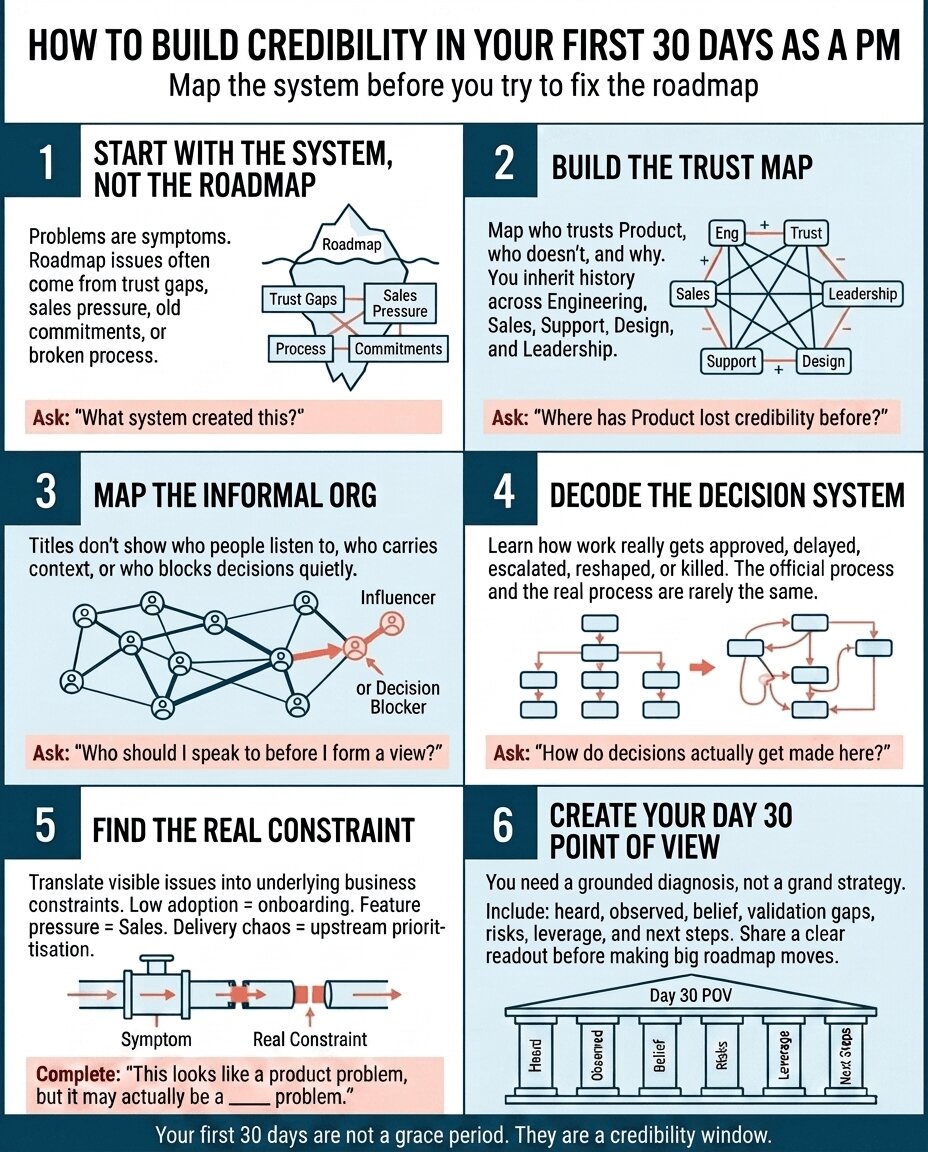
The First 30 Days Are Not Just About Onboarding
Your first 30 days are not onboarding anymore
In a senior product role, the first month is a credibility window, not a grace period. Here is how to use it to build judgment instead of performing competence.
TL;DR
The first 30 days in a senior role are a credibility window, not onboarding. People judge your judgment before you ship anything.
The mistake experienced PMs make is proving value too fast: auditing the roadmap and fixing visible problems before understanding the system that created them.
Seniority is not how fast you form opinions. It is how accurately you read context before acting.
Spend the month diagnosing four things: the business pressure behind the role, the stakeholder power map, the hidden operating system, and where trust has been built and broken.
Your Day 30 deliverable is a grounded point of view, not a grand strategy.
Why your first 30 days are a credibility window, not onboarding
I have watched strong senior PMs lose credibility in their first 30 days. Not because they lacked talent, product sense, customer empathy, or execution. Because they misunderstood what the first 30 days were actually for.
They treated the first month like onboarding. Read the docs. Meet the team. Review the roadmap. Find the dashboards. Sit in on customer calls. Start forming opinions. That sounds responsible, and ten years ago it might have been enough.
The reality of tech has changed. There is less patience now, less slack, less room for "let me get settled." Teams are leaner, managers are stretched, and executives are watching spend more closely. Product teams are under pressure to prove they create business value, not just coordinate work. The old grace period is gone.
Your first 30 days are not a warm-up. They are a credibility window. People are forming impressions immediately: does this person get it, can they operate at this level, are they strategic or just busy, will they make my life easier or harder, can I trust their judgment. And those judgments often form before you ship anything, before you make a roadmap call, before you present your first strategy. People are watching how you enter the room, what you ask, what you assume, what you challenge, and whether you can read the system before trying to change it.
What the first 30 days are actually for
The first 30 days are not about proving you are smart. That is the trap.
Most high performers walk in under pressure to prove the company made the right decision. So they perform competence. They talk too early, diagnose too fast, and offer solutions before they understand constraints. They assume the visible problem is the real problem, and they mistake activity for credibility.
But the visible problems are rarely the whole problem. The roadmap may be messy because Sales has overpromised for two years, not because people lack discipline. Engineering may be resistant because they are exhausted from past PMs committing without understanding architectural constraints, not because they "don't get product." Stakeholders may be skeptical because Product lost trust before you arrived, not because they are political. A customer complaint about a missing feature may actually be about onboarding, pricing, expectation-setting, or a business model that no longer fits the customer.
If you jump straight into fixing, you may fix the wrong thing. Worse, you may threaten the wrong person, reopen an old wound, or challenge a decision that has history behind it. That is how experienced people lose trust fast. Not because their instincts are bad. Because their timing is.
Seniority is not how quickly you generate opinions. It is how accurately you read context before acting. In a new role, your job is not to prove you have answers. It is to prove you know how to learn the right things. Instead of asking "what should I change," you start with "what system did I just enter." Every product lives inside a business system, a team system, a trust system, a decision system, a power system, and a historical system. Miss the system and your product judgment is incomplete, even when you are technically right.
What does strategic look like in your first 30 days?
Strategic means knowing what to understand before you recommend change. It does not mean arriving with a big vision, finding the most obvious flaw, or challenging the roadmap by Week 2.
In practice it means asking better questions, learning where trust has been built and broken, and understanding how decisions actually happen versus how the process says they happen. It means knowing what your manager needs before they have to manage you, distinguishing a product problem from an organizational problem, and seeing the difference between "this is broken" and "this exists because of a constraint I do not yet understand."
The strongest PMs do not spend their first 30 days trying to look impressive. They spend them building judgment.
How to understand the business pressure behind your role
Before you dive into the product, understand why the role exists now. A company does not hire a senior PM just because there is work to do. It hires because something needs to change, accelerate, stabilize, or become less chaotic. Maybe it needs growth, retention, enterprise expansion, or margin. Maybe Product needs to rebuild trust with Sales, Engineering, or the executive team. Maybe your manager is overwhelmed and needs leverage. Your first job is to understand the pressure behind the seat.
Ask your manager:
What problem was this role hired to solve?
What would make you confident in me by Day 30?
What would make you say, six months from now, that hiring me was clearly the right call?
What are the business pressures behind this team's current priorities?
What do you need more of from this role: speed, clarity, alignment, customer insight, stakeholder management, execution, or strategy?
What should I absolutely not touch yet?
That last question matters. Every new role has landmines: things that look broken but are politically sensitive, decisions that look irrational but were made under pressure, topics where the organization has scar tissue. Learn where not to step before you try to move fast.
How to run your first 1:1s as diagnostic interviews
Your first 1:1s are not casual intro chats. They are diagnostic interviews. Generic rapport questions are fine, but they are not enough. You are trying to understand the system beneath the org chart.
Ask stakeholders:
What is working better than people realize?
What is more fragile than it looks?
What keeps getting discussed but never resolved?
What has already been tried?
Where has Product historically helped, and where has it created friction?
What would you want me to understand before I make recommendations?
What does a great PM do here, and what does a bad one do?
That last question is gold, because every organization has a local definition of credibility. In one company "great" means decisive, in another collaborative, in another data-driven or executive-ready. Learn the local definition of good, or you will perform competence in a language nobody values.
After each 1:1, do not just record what people said. Write down three things: what they explicitly said, what they implied but did not say, and what they seem to fear, want, or protect. That third one is where the strategic insight lives. People rarely tell you the whole truth in a first conversation, but they give you signals about what they are tired of, what they no longer trust, and what they are afraid will happen again.
How to map the stakeholder power system
Most PMs ask "who are the stakeholders." That is not enough. You need to know who decides, who influences, who blocks, who carries history, and who shapes perception. The org chart will not tell you that.
Sometimes the most influential person is not the executive sponsor. It is the staff engineer who has watched five PMs rotate through, the Customer Success leader who knows where the product promise breaks, or your manager's peer quietly shaping how your work is perceived.
Ask:
How do decisions actually get made here?
Who needs to be involved early versus informed later?
Who has strong opinions about this product area?
Who has been burned by past decisions?
Whose trust matters most for this role to be effective?
Where does alignment usually break down?
Who has more influence than their title suggests?
This is not politics in the gross sense. It is leadership. At senior levels your job is not just to make good product calls, it is to make good product calls that can survive the organization. That requires understanding power, trust, incentives, and timing.
How to manage up in your first 30 days
Managing up does not mean sending status updates. It means reducing ambiguity and making your thinking visible, so your manager trusts how you are processing the work before they see final outputs. Your manager should never have to wonder what you are doing, what you are learning, whether you understand what matters, or whether you are going to surprise them.
Ask your manager directly:
How do you prefer to stay informed, and at what level of detail?
What decisions should I make independently, and which should I bring to you first?
What are your biggest concerns about this product area?
What organizational dynamics should I be aware of?
What does the executive team care about most right now?
Where do you need me to create leverage for you?
What would make you lose confidence in someone in this role?
Then send a simple weekly update that is a judgment update, not a status dump: what I am learning, what patterns I am seeing, where I see risk, where I see opportunity, what I am doing next, and where I need your guidance. This looks strategic because you are showing how you think. Your manager hired you for judgment, so show them your judgment forming.
How to learn a team's hidden operating system
Every team has two operating systems. The official one is the roadmap process, planning rituals, OKRs, dashboards, sprint ceremonies, and decision docs. The real one is who actually decides, what gets escalated, what gets ignored, what creates urgency, what gets rewarded, what gets punished, and what people are afraid to challenge. Your job is to understand both.
Ask:
How does prioritization actually happen, and what causes priorities to change?
What gets called urgent here?
What kinds of problems get executive attention?
What work is valued but invisible?
What topics are politically sensitive?
Where do teams tend to overcommit?
What meetings really matter, and which are performative?
What previous attempts failed?
This is where many experienced PMs fail. They understand product but not the organization. In senior roles, the organization is part of the product. You cannot separate the roadmap from the operating system that creates it, or the strategy from the trust required to execute it. If you only diagnose the artifact, you miss the machine.
Why you should earn trust before challenging anything
Many senior people challenge too early. They see the dysfunction, the roadmap issues, the product debt, the missed opportunities, and they say it out loud before they have enough trust. They may be right. But being right is not the same as being effective.
Before you challenge, understand the history. Ask why the decision was made, what constraint existed at the time, what tradeoff the team was making, what would break if you changed it, who would be impacted, and what would need to be true for it to change. This keeps you from becoming the new person who thinks they are the first to notice the obvious.
A useful phrase to keep on hand: "I am noticing something, but I want to understand the history before I form a strong opinion." It signals curiosity, humility, and judgment, and it gives people the chance to tell you the backstory before you accidentally step into it.
What your Day 30 output should be
By Day 30 you do not need a giant strategy deck, a solved roadmap, or a bold new vision. You need a grounded point of view.
A grounded point of view says: here is what I heard, here is what I observed, here is what seems true, here is what still needs validation, here is where I see risk, here is where I see leverage, and here is what I recommend next. That kind of readout tells your manager and stakeholders that you listened, learned the system, understood the pressure, and saw the patterns, instead of rushing to perform brilliance. That is what makes people trust senior leaders. Not certainty. Discernment.
The real first 30-day question
Most people spend their first month trying to answer "how do I prove I belong here." The better question is "how do value, trust, power, and decisions move through this organization." Once you understand that, your recommendations get sharper, your timing improves, your manager trusts you faster, your stakeholders feel less threatened, and your product judgment lands because it is grounded in reality.
That is the difference between looking busy and looking senior. The first 30 days are no longer a grace period. They are a leadership audition. Use them to read the room, understand the business pressure, map trust, manage up, learn the hidden operating system, and form a point of view before forcing a strategy. The strongest people do not rush to prove they are smart. They build the context required to be right.
Frequently asked questions
What should a senior PM do in the first 30 days of a new job?
Spend the first 30 days diagnosing the system rather than fixing visible problems. Understand the business pressure behind the role, map who really holds influence, learn how decisions actually get made, and find where trust has been built and broken. By Day 30, deliver a grounded point of view rather than a finished strategy.
Are the first 30 days still a grace period?
No. In modern tech orgs the first 30 days are a credibility window, not onboarding. Teams are leaner and managers are stretched, so people form impressions about your judgment immediately, often before you ship anything.
What is the biggest mistake experienced PMs make in a new role?
Trying to prove value too fast. They audit the roadmap, point out gaps, and start fixing what looks broken before they understand the constraints and history behind it. This reads as tactical, and it can threaten the wrong people or reopen old wounds.
What does strategic mean in the first 30 days?
Strategic means knowing what to understand before you recommend change. It is asking better questions, learning where trust lives, and distinguishing a product problem from an organizational problem, rather than arriving with a big vision or challenging the roadmap in Week 2.
What questions should you ask your manager when starting a senior role?
Ask what problem the role was hired to solve, what would make them confident in you by Day 30, what business pressures sit behind current priorities, what they need most from the role, and what you should not touch yet. The last question surfaces the political landmines before you step on them.
What should your output be at Day 30 as a new product leader?
A grounded point of view, not a grand strategy. It states what you heard and observed, what seems true, what still needs validation, where the risks and leverage are, and what you recommend next. This builds trust because it shows discernment instead of forced certainty.
How do you build trust in a new product role?
Earn trust before you challenge anything. Understand the history behind a decision before critiquing it, and make your thinking visible to your manager through judgment-based updates rather than status dumps. Being right is not the same as being effective, and timing is what protects your credibility.
About the author
Lynne Levy coaches senior technology leaders through transitions, reorgs, and the politics of advancement. She spent more than twenty years as a product, marketing, and strategy operator before coaching, and has since worked with more than 900 leaders on reading organizational systems, building trust, and making product calls that survive the org.
