Performative Availability: Why Remote Tech Workers Are Working More, Not Less
TL;DR
Remote tech workers are not coasting — they are performing availability to prove they are working
Visibility-based management is a leadership problem, not a people problem
The fix: measure outcomes, not hours online
Performative availability is what happens when remote workers spend more energy looking busy than doing the work, and it is a leadership problem, not a people problem.
The remote work debate has the wrong frame. The question is not whether people work hard from home. The question is why so many of them feel they have to prove it every fifteen minutes.
Remote tech workers are not coasting. They are demonstrating their commitment with nonstop availability. And that is the part of the conversation nobody wants to say out loud.
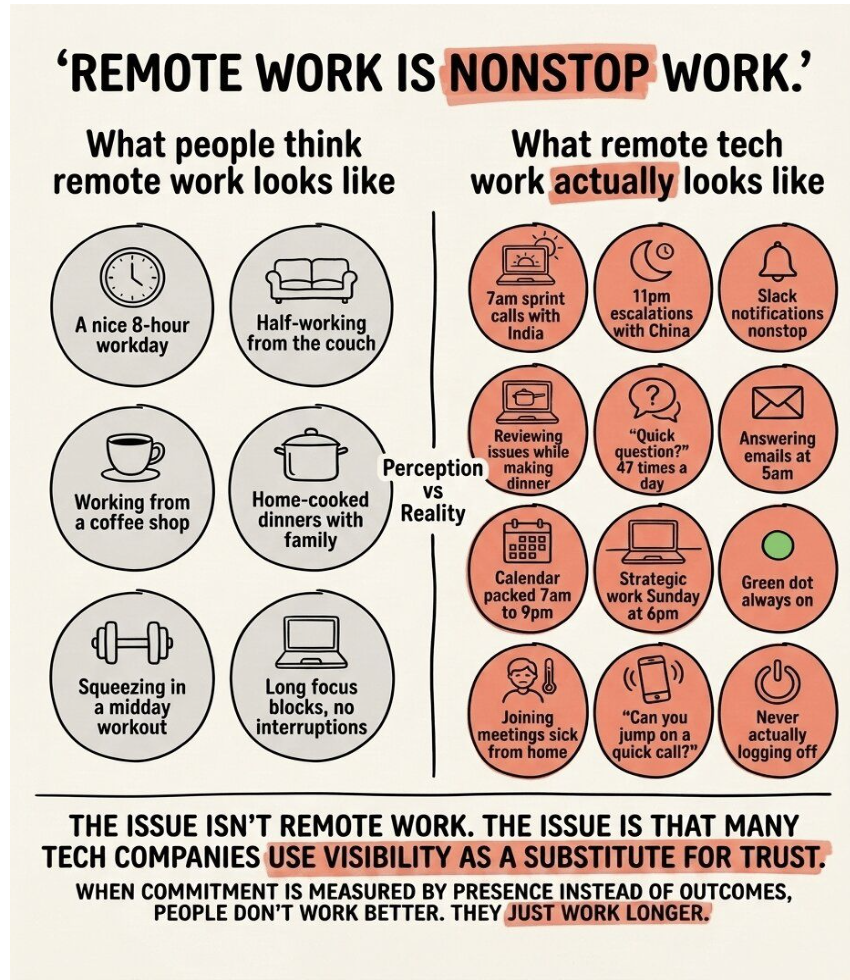
Perception vs reality: what remote tech work actually looks like when commitment is measured by visibility instead of outcomes.
What Is Performative Availability?
Performative availability is the behavior of staying visibly responsive (green dot on, Slack replies fast, calendar full) to signal commitment in environments where managers cannot see the actual work happening. It is not the same as working hard. It is the appearance of working hard, sustained across hours that no contract requires.
When people fear their commitment is being judged through visibility, they compensate with availability.
How It Shows Up in a Tech Workday
The pattern is consistent across the senior individual contributors and engineering leaders I coach:
More standups accepted than the role actually needs
Faster Slack replies than the work warrants
Earlier Jira updates than anyone reads
Later incident calls than rotation requires
More "I can jump on" than the calendar can hold
They pick their kids up from school at 2pm. They log back on at 2:17. They review pull requests while making dinner. They answer Slack before breakfast. They join 7am calls with India and handle 11pm escalations with China. They move Jira tickets on Sunday night so Monday looks under control.
Not because the work requires it. Because the culture does.
The Scene Behind the Pattern
I have taken calls at 8pm while making dinner. Kids waiting. Headphones in. Green dot on. Calendar full. Slack responsive. Tickets moving.
That scene is not unusual. It is the operating reality for thousands of remote tech professionals right now. They are doing more than they have ever done. And they are still being asked to prove they are working.
Because none of that effort is physically visible, they feel pressure to make themselves digitally visible instead. The visibility becomes a second job layered on top of the first.
The Real Issue Is Not Remote Work
The issue is that many tech companies still use visibility as a substitute for trust.
When commitment is measured by presence instead of outcomes, people do not work better. They just work longer. The output stays the same. The hours expand to fill the surveillance.
This is a management problem, not a remote work problem. A culture that constantly needs proof of work usually has a deeper problem with trust. The green dot is not a productivity tool. It is a comfort blanket for leaders who never learned to measure outcomes.
What This Costs Companies
Three things, in order:
Your best people leave first. Senior ICs and tech leaders with options will not stay in cultures that audit their attention all day. They will move to companies that hire on outcomes.
The work quality drops anyway. Constant context-switching to maintain availability fragments the deep work that senior technical roles actually require.
You build a reputation. Engineers talk. The companies known for green-dot culture get filtered out of the candidate pools that matter.
The companies still tracking green dots are going to lose their best people to companies that don't need to.
What Leaders Can Do Instead
If you manage remote tech workers, the shift is not complicated. It is just uncomfortable.
Define what done looks like. Outcomes, deliverables, decisions made. Not hours logged.
Stop rewarding response speed. A two-hour Slack reply is not a performance issue. Praising the ninety-second reply is.
Audit your own behavior. If you message your team at 9pm, they hear it as a standard, no matter what you say about boundaries.
Make focus time legible. Block calendar time for deep work and protect it publicly. Your team copies what you do, not what you announce.
What Remote Workers Can Do for Themselves
You cannot fix your company's trust problem alone. You can stop volunteering for the audit.
Stop performing visibility on top of your actual work. Pick one channel where you are responsive. Let the rest wait.
Make your outcomes visible instead of your availability. A weekly note on what you shipped does more than ten Slack replies.
Notice when you are answering to prove, not to help. That is the tell. The 11pm reply that no one asked for is the symptom.
Key Highlights
Performative availability is a management problem, not a people problem
Visibility-based cultures lose their best people first
Deep work cannot happen when your job is to also look busy all day
The 11pm reply no one asked for is a symptom, not a virtue
FAQ
What is performative availability at work? Performative availability is the behavior of staying visibly online and responsive to signal commitment, even when the work does not require it. It is most common in remote tech environments where managers cannot directly observe output.
Why do remote workers feel pressure to always be available? Because visibility has replaced trust as the default management signal. When leaders cannot see the work, they read responsiveness as a proxy for effort. Workers learn this quickly and compensate by staying digitally visible at all hours.
Is remote work the cause of burnout in tech? No. The cause is visibility-based management applied to remote work. Remote work itself, when paired with outcome-based trust, produces better focus and lower burnout. The combination of remote work and surveillance culture is what burns people out.
How can I tell if my company has a trust problem? Look at what gets noticed. If response time is praised more than results, if green-dot status is referenced in reviews, if leaders send messages outside hours and expect replies, the company is measuring presence instead of outcomes.
What should I do if I am stuck in this culture? Start by separating performance of work from actual work. Make your outcomes visible on a weekly cadence. Pull back on after-hours responsiveness in small, defendable increments. And start looking. Companies that hire on outcomes exist, and they are hiring.
Lynne Levy coaches senior tech leaders and engineering executives on navigating organizational complexity, building influence, and protecting their judgment in environments that do not always reward it. Subscribe to The Arena newsletter for weekly notes on leadership and corporate navigation.
One observable question for you: What is the last time you stayed online past the work, just to prove the work was happening?