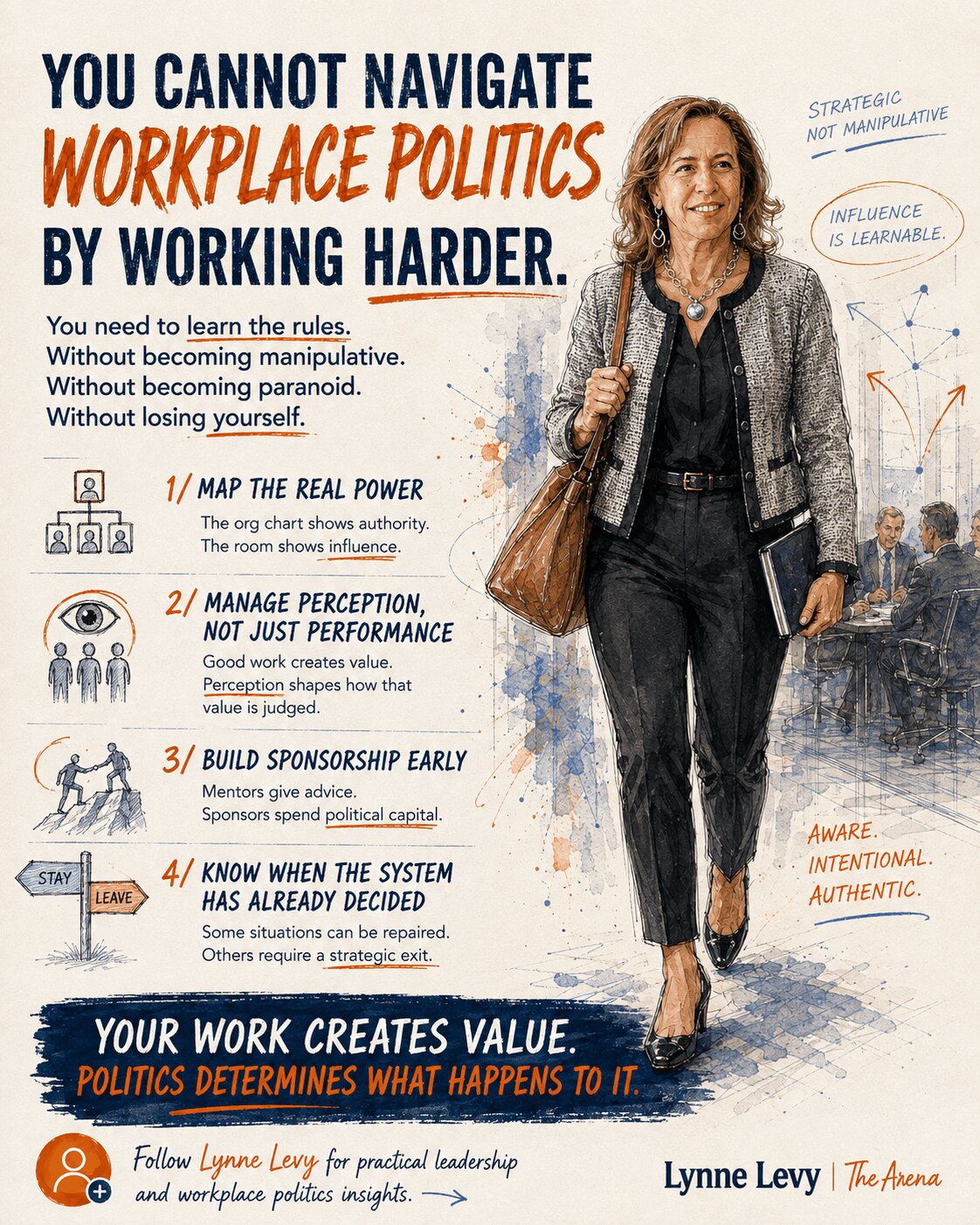
To Level Up-You Can't Just Outwork the Reality of Politics
You Cannot Outwork Workplace Politics
TL;DR
Workplace politics is not separate from performance. It is how organizations decide who to trust when information is incomplete.
Working harder cannot repair a damaged relationship, change a narrative, or replace a sponsor who has stopped advocating for you.
Four moves protect a career from political blind spots: map the real power, manage perception, build sponsorship early, and recognize when a decision has already been made.
Most ambitious people believe that if they become exceptional enough, workplace politics eventually stops mattering. It does not. The more senior you become, the more political your environment gets, and the leaders who understand this early protect their careers. The ones who do not keep working harder at a problem that output was never going to fix.
What mistake do high performers make with workplace politics?
Most people assume workplace politics is separate from performance. It is not.
Politics is simply how organizations make decisions when information is incomplete. Every leadership team is constantly asking who they can trust, who represents the culture, who creates confidence, who creates risk, and who can influence others. Those questions are rarely answered by performance metrics alone. They are answered through relationships, reputation, perception, and influence.
That does not mean performance stops mattering. It means performance is only one input into a much larger decision.
Working harder cannot make someone trust you. It cannot repair a damaged relationship. It cannot stop a narrative spreading after you have left the room. And it cannot replace the executive who quietly advocated for you every time your name came up.
By the time you realize the real problem is political, someone else often controls the story.
How do you map the real power in an organization?
The first mistake people make is confusing authority with influence. The organization chart tells you who has authority. It rarely tells you who has influence.
Every organization has unofficial power structures: people who shape opinions before meetings begin, people whose approval matters more than their title suggests, people everyone consults before making important decisions, and people who quietly kill ideas without ever taking ownership for saying no.
Whenever you enter a new organization or a new leadership team, spend less time asking who reports to whom, and more time asking who influences decisions before they become decisions, who the CEO instinctively trusts, and who gets listened to even when they speak last.
If you do not know where power actually sits, you are flying blind.
Why does managing perception matter as much as performance?
People do not respond to who you are. They respond to who they believe you are. Those are not always the same thing.
Most professionals obsess over improving performance. Very few actively manage perception, which does not mean becoming fake. It means becoming intentional about what you are known for, what assumptions people make about you, and who is shaping the stories told about you when you leave the room.
Perception compounds. A single interaction rarely changes your reputation. Hundreds of small interactions do.
I coached a senior engineer, Daniel, through exactly this. His VP, Renata, was hard on him. Not distant, hard. The more he shipped, the more she found wrong with it.
He did the thing that had always worked before. He worked harder. Longer hours, faster delivery, volunteered for the projects nobody wanted. It did not soften her. If anything, the closer he got to matching her pace, the sharper her feedback got.
He was convinced the problem was output. It was not. He did not love hearing that, at first.
Renata was not grading him against a technical bar. She was grading him against what her own boss, the engineering VP two levels up, was pushing her on that quarter: predictability, not velocity. She had been burned publicly for a team that shipped fast and broke things. Every extra thing Daniel volunteered for read to her as more surface area for something to go wrong, not more value delivered. He was playing to a scoreboard that was not hers.
Once that became visible, the fix was not more hours. It was different hours. Daniel stopped volunteering for scope and started narrating risk before Renata had to ask for it. He gave her the exact thing she needed to look good to her own boss. Within two quarters, she was the one pushing his promotion case up the chain.
How do you build sponsorship before you need it?
One of the biggest career mistakes is confusing mentors with sponsors. Mentors help you grow. Sponsors help you advance. Mentors give advice. Sponsors spend political capital.
A sponsor is the person who says your name when opportunities appear, defends your decisions when criticism arrives, and creates opportunities you never even knew existed.
The mistake most professionals make is trying to build sponsorship during a crisis. By then it is too late. Political capital works like trust: it has to be built before it is needed.
If your career depends entirely on your own voice, you are more vulnerable than you think. The strongest careers are built by people whose reputation continues traveling after they leave the room.
How do you know when an organization has already decided about you?
This is the hardest lesson. Sometimes the system has already made up its mind.
You can rebuild trust, repair misunderstandings, change perceptions, and find new sponsors. But occasionally the organization has quietly decided who you are. When that happens, many high achievers make one final mistake: they work even harder, believing one more project or one more late night will finally change everything. Usually it does not, because the discussion is no longer about performance. It is about identity.
When organizations stop seeing your future, no amount of extra output changes the conversation. Recognizing that early is not quitting. It is strategy. Sometimes the highest-return decision is not proving yourself. It is placing yourself in an environment that values what you already bring.
Is workplace politics the same as manipulation?
No. Good politics is not manipulation. It is awareness: understanding how trust is built, how influence works, how decisions actually get made, how reputations are formed, and how careers accelerate or quietly stall.
The leaders who handle politics best are rarely the loudest. They are simply the clearest. They understand people, incentives, and power, and they know how to protect both their reputation and their integrity at the same time.
That is the real goal: not winning political games, but understanding the rules well enough that you no longer become a victim of them. Your work creates value. But people, power, and perception determine what happens to that value next.
Key Highlights
Politics is how organizations decide who to trust under incomplete information, not a distraction from performance.
Authority sits on the org chart. Influence does not, and only one of them actually decides outcomes.
Sponsors spend political capital on your behalf. Mentors only give advice, and the difference decides who advances.
A political decision already made cannot be outworked. It can only be recognized early enough to act on.
FAQ
Can you overcome workplace politics by working harder?
No. Working harder increases output, but workplace politics is decided by trust, perception, and sponsorship, not by volume of work. In some cases, more output without a matching change in perception can even read as more risk to a skeptical manager.
What is the difference between a mentor and a sponsor at work?
A mentor gives advice and helps you grow. A sponsor spends political capital on your behalf, advocating for you in rooms you are not in and creating opportunities you would not otherwise access. Careers advance through sponsorship more than mentorship.
How do you know if your company has already decided your future?
Warning signs include a stalled promotion despite strong results, a shrinking scope of responsibility, or repeated exclusion from key rooms and decisions. When the conversation stops being about performance and starts feeling like it is about identity, the system has likely already decided.
If this hit home, subscribe to The Arena. Every week I dig into the hidden dynamics of leadership, influence, workplace politics and career strategy that shape success long before anyone notices the results.
