11 Habits That Put Your Job At Risk
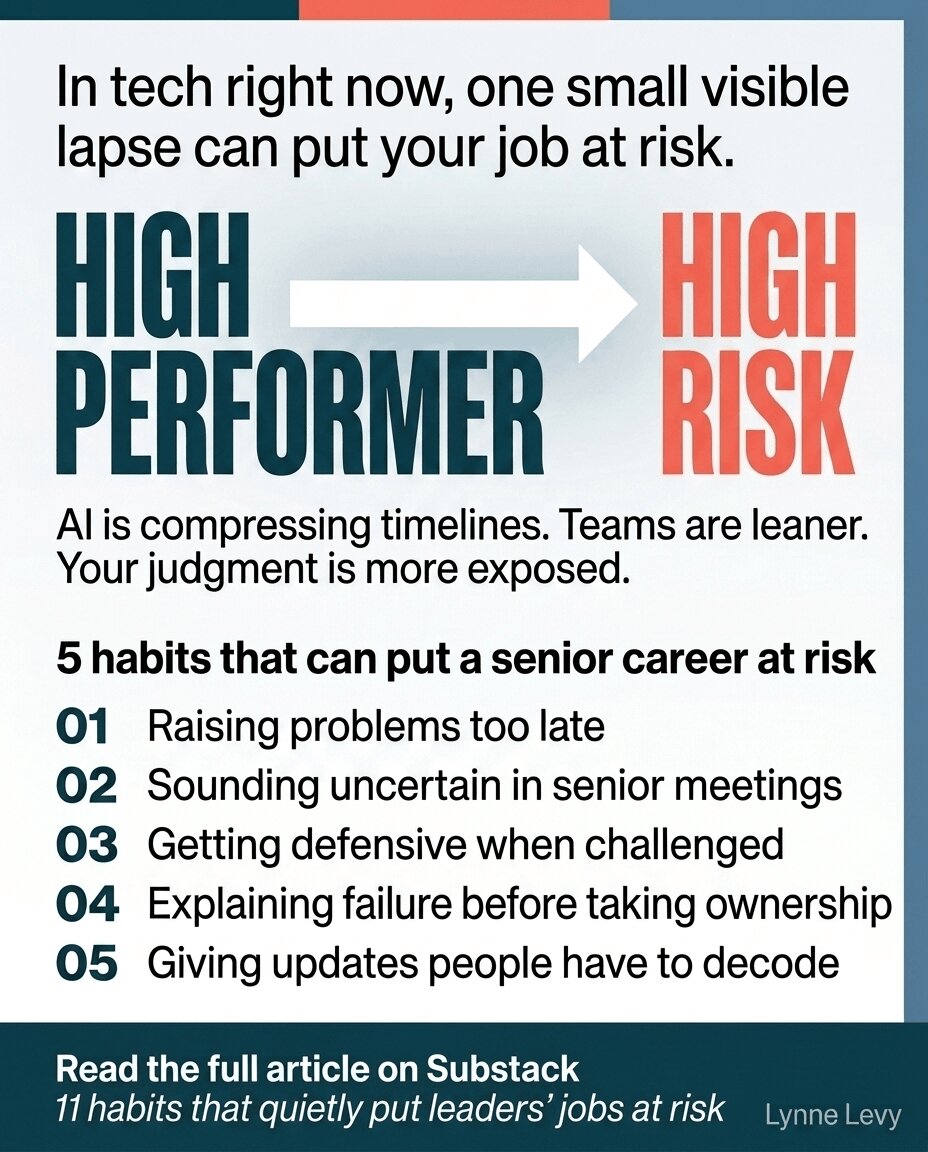
11 Leadership Habits That Put High Performers at Risk
Discover 11 quiet leadership habits that create career risk at work, and what high performing leaders should do instead to protect trust.
How High Performers Become High Risk
TL;DR
Senior careers are shaped by how people experience your judgment under pressure, not by performance alone.
Eleven common leadership habits, from slow responses to vague updates, quietly create doubt even when the work itself is strong.
Each habit has a direct fix: clear timelines, structured updates, early escalation, and honest ownership build trust instead of uncertainty.
A high performing leader can lose credibility in one meeting, not because her results changed, but because her judgment came into question. This article
breaks down eleven habits that quietly put strong performers at risk in a faster, leaner workplace, and what to do instead.
A client called me in a panic after receiving negative feedback. She had appeared uncertain in one senior meeting. Everyone noticed. Just one small moment, and suddenly her job was at risk.
Until then, she had been considered a high performer. Her expertise had not changed. Her results had not disappeared. But confidence in her judgment had shifted.
That may sound unfair. But senior careers are not shaped by performance alone. They are also shaped by how other people experience you when the pressure rises.
Can you make a decision when the answer is not obvious? Can you communicate clearly when the situation is complicated? Will you raise a problem before it becomes a crisis? Do you create confidence, or do you create more uncertainty?
These questions have always mattered. Now they matter more.
AI is making work move faster than most people can realistically absorb. Teams are getting leaner. Reorganizations are constant. Leadership changes quickly. Priorities can shift before people have finished processing the last set of instructions. And when companies are asking fewer people to carry more responsibility, the tolerance for uncertainty falls.
You do not need to make one catastrophic mistake to damage your career. Sometimes, you only need to create enough doubt.
Here are 11 habits quietly putting leaders and experts at risk, and what to do instead.
Are You Making People Chase You for a Response?
You saw the message. You meant to respond. You planned to come back to it when you had more information. Meanwhile, three people are blocked. Someone else is forced to explain your silence. And the work starts moving around you.
This is not simply a communication problem. It teaches people that involving you creates delay. That is when the real career risk begins. People stop waiting. They stop asking. They find another route.
What to do insteadAcknowledge the request and give a clear response time. "Got it. I will come back to you by 3 PM." You do not need to have the answer immediately. You need to remove the uncertainty.
Do Your Updates Force Everyone Else to Investigate?
"Making progress." "Still working through it." "Should be ready soon."
These sound like updates. But they do not tell anyone whether the work is on track. They force the reader to ask more questions. What has actually been completed? What remains? Is the deadline still realistic? Is there a problem I should know about?
A vague update transfers the work of understanding your project to everyone around you. Senior people notice this quickly.
What to do insteadUse a simple structure: Done, what has been completed. Next, what is happening now. Blocked, what could prevent progress. Then include one number, date, decision or concrete detail. Clarity builds confidence. Vagueness creates more work.
Are You Hiding Problems Until You Run Out of Options?
The deadline did not suddenly slip this morning. The warning signs were probably visible last week. But you hoped you could fix everything before anyone noticed.
Now the team has fewer choices. The customer has less patience. Leadership has less time to respond. And what could have been managed now looks like a surprise.
Leaders are rarely judged for encountering problems. They are judged for when they reveal them. Bad news delivered early is information. Bad news delivered late is damage.
What to do insteadRaise the risk while there are still options. Explain what is happening, what the likely impact will be, what choices remain, and what you recommend doing next. Escalation is not failure. Late escalation is.
Do You Sound Uncertain When the Room Needs a Recommendation?
Experts often believe their value comes from presenting every possibility. They explain the nuance. They introduce the caveats. They describe all the competing interpretations. Then they wait for someone else to decide.
That may feel intellectually responsible. In a senior meeting, it can look like you do not know what should happen. Your role is not only to understand complexity. It is to help other people move through it.
What to do insteadLead with your recommendation. Then explain why you believe it is the best option, what evidence supports it, what tradeoff you are accepting, and what would cause you to change your mind. You are allowed to acknowledge uncertainty. But do not make the room carry it for you.
Are You Taking Ten Minutes to Say What Should Take One?
The more complicated an issue becomes, the more tempting it is to talk your way toward the answer. You begin with the background. Then the history. Then the stakeholder context. Then the three conversations that happened before the meeting. By the time you reach your recommendation, the room has stopped listening.
Rambling does more than waste time. It makes people question whether you can distinguish the important from the merely interesting. That is dangerous at senior levels.
What to do insteadUse this order: recommendation, essential evidence, risk or tradeoff, decision required, owner and next step. People should not have to extract the point from you.
Are Your Decisions Confusing the People Who Depend on You?
"We are going in a different direction." "Leadership has changed its mind." "This is no longer the priority."
The decision may be completely reasonable. But without context, it can look political, reactive or poorly considered. People begin to question whether the work they are doing today will still matter tomorrow. That destroys confidence and slows execution.
What to do insteadExplain what changed, what information influenced the decision, what options were considered, what tradeoff was accepted, and what this means for the work already in progress. People do not need to agree with every decision. They need to understand how you reached it.
Are You Running the Real Organization Through Private Messages?
Direct messages feel faster. They are convenient. They avoid another meeting or a long thread. But when decisions, commitments and context are scattered across private conversations, people start working from different versions of the truth.
One person thinks the project is approved. Another thinks it is still under discussion. Someone else has never heard of it. Private communication may feel efficient in the moment. It often creates operational chaos later.
What to do insteadKeep important work in shared channels whenever possible. When a significant decision is made privately, summarize it where everyone affected can see it. Include what was decided, why it was decided, who owns the next step, and when it will happen. Speed is only useful when everyone is moving in the same direction.
Do You Treat Feedback Like an Accusation?
It is natural to explain yourself when feedback feels unfair. You want to correct the details. You want to provide the missing context. You want the other person to understand why their interpretation is wrong.
But when every example becomes something to debate, people eventually stop telling you what you need to know. Not because the problem disappeared. Because talking to you became too exhausting. That is one of the most dangerous positions a leader can be in. The feedback does not stop. It simply moves into conversations you are not invited to.
What to do insteadBefore defending yourself, repeat what you heard. Ask what impact the behavior created. Look for the useful part, even when you disagree with the delivery or conclusion. You can challenge inaccurate feedback. But first prove that you can receive it. The most dangerous feedback is the feedback people decide not to give you.
Are You Becoming Unpredictably Unavailable?
You do not need to respond instantly. You do not need to be permanently online. You do not need to sacrifice your evenings to prove that you care. But people do need to know whether they will hear from you today or next week.
When your availability becomes unpredictable, work begins routing around you. Decisions happen without you. Information reaches you late. Your influence quietly shrinks. This often gets misread as healthy boundaries. Boundaries are clear. Unpredictability is not.
What to do insteadSet expectations. Tell people when you are heads down. Explain when you will respond. Create a clear route for genuinely urgent issues. You can protect your time without making other people guess.
Do You Explain Every Failure Through Someone Else's Mistake?
The requirements changed. Leadership would not decide. Engineering missed the estimate. The customer kept adding demands. The supplier let you down. The AI output was poor.
All of that may be true. But when nothing is ever your responsibility, people stop trusting your version of events. They begin to assume every story has another side. Senior credibility depends on being able to separate context from accountability.
What to do insteadOwn your contribution without taking responsibility for everything. Say what you could have done differently, what you will do now, what process needs to change, and how you will reduce the chance of it happening again. Accountability does not weaken your position. It makes your judgment easier to trust.
Do You Say Yes in the Room, Then Fail in Private?
You agree to the deadline because you want to appear helpful. You nod when the scope expands. You accept another priority without discussing what will stop. Then you complain about the commitment afterward. Eventually, you miss it.
Now you look less reliable than if you had challenged the request in the first place. This is not collaboration. It is delayed disagreement. And it creates the worst possible combination: the organization makes plans based on your promise, you carry resentment about a commitment you accepted, and the result still does not arrive.
What to do insteadNegotiate before committing. Discuss the scope, timeline, resources and tradeoffs. Be explicit about what must pause if something new becomes urgent. Then raise likely slippage the moment you see it. A difficult conversation before the deadline is better than an excuse after it.
The Real Risk Is Not One Mistake
None of these habits proves that someone is bad at their job. Most are understandable responses to pressure. People are overloaded. Their attention is fragmented. They are trying to move quickly while absorbing constant change.
The problem is what happens when these behaviors become patterns. Patterns create doubt. Can we rely on her? Will he tell us when something is going wrong? Does she know what matters? Can he make a decision? Will she handle difficult feedback? Do we need to manage around him?
That doubt follows your name. It enters performance reviews. It shapes promotion discussions. It influences who is trusted with important work. It matters during reorganizations. And it matters when leaders are deciding which roles they can no longer afford to keep.
AI is making output faster and cheaper. More people can now draft the document, summarize the meeting, analyze the information and produce the presentation. That does not make human judgment less valuable. It makes it more visible.
When producing work becomes easier, the real differentiator is whether people trust you with complexity. Do you reduce uncertainty? Do you create clarity? Do you raise problems early? Do you make the people around you faster? Can you remain useful when the situation becomes uncomfortable?
Being easy to work with does not mean agreeing with everyone. It does not mean responding around the clock. It does not mean making yourself smaller. It means people know where things stand with you. They know what you will do. They know when you will do it. And they trust you to speak up before a problem becomes a crisis.
In a workplace moving this fast, trust is not a soft skill. It is career protection.
Key Highlights
Career risk often comes from a pattern of small doubts, not one major failure.
Clear communication, including response times and structured status updates, stops people from routing work around you.
Early escalation and honest ownership of mistakes build more trust than avoiding blame.
As AI makes output easier to produce, human judgment under pressure becomes the real differentiator between leaders.
Frequently Asked Questions
What makes a high performing leader suddenly seem high risk?
A leader becomes high risk when colleagues start doubting their judgment under pressure, even if actual results have not changed. One uncertain moment in a senior meeting can trigger doubt that later shows up in performance reviews and promotion decisions. The shift happens through perception, not a drop in real performance.
Why do vague status updates hurt a leader's credibility?
Vague updates such as "making progress" force colleagues to ask follow up questions to understand the real status of a project. This transfers the mental work of tracking that project onto everyone else involved. Senior leaders notice this pattern quickly and begin to question the person's grip on their own work.
How does AI change the risk of these leadership habits?
AI is making it faster and cheaper for anyone to draft documents, summarize meetings, and analyze data. That shift makes human judgment more visible rather than less valuable, because trust and clarity under pressure cannot be automated. Leaders who reduce uncertainty and communicate clearly become the differentiator on their teams.
I write every day about how leaders and experts can manage the chaos of technology without sacrificing their health, relationships or life outside work.
Subscribe to join me.

