Why Hard Work Alone Will Not Get Your Promoted
Why Hard Work Alone Will Not Get Your Promoted to Director
TL;DR:
Promotion to Director is not a reward for hard work. It is a selection process with entirely different criteria. Your value shifts from what you personally deliver to what changes in the business because of your work. In flatter orgs with fewer seats, the deciding factor is whether your manager can defend you in a ten-minute conversation you’re not in. That requires a story about impact, not activity.
One of the most damaging beliefs in tech careers:
“If I just work hard enough, I’ll get promoted to Director.”
It sounds reasonable. It is also wrong. And the people who hold it most tightly are the ones who stay stuck the longest.
The unspoken rule nobody tells you about Director promotion
Promotion to Director is not a reward system.
It is a selection process. The criteria are entirely different from what got you here. And almost no one explains this before you’ve already lost two or three cycles trying to crack a code that doesn’t work.
Here is what Director-level promotion actually is: a constrained decision, made in a room you are not in, by leaders who are pressure-testing a story about you, not reviewing your deliverables.
What actually changes at the Director level
For most of a tech career, your value is tied to what you personally deliver.
At the Director level, your value is tied to what changes in the business because of your work.
Not what you shipped. What decisions got made differently? What risks were reduced? What opportunities were unlocked? What the organization can now do that it couldn’t before.
That is a different currency. And most high-performing Senior PMs and Engineering Leaders are still spending the old one.
This is not a communication gap. It is a shift in how value is defined.
Why does fewer Director seats change the math
Tech organizations are flatter than they used to be. Fewer layers. Wider spans of control. Fewer Director roles than there were five years ago.
Which means the question in that room is no longer: “Is this person strong?”
It is: “Is this person operating at a level we can defend at the leadership table?”
Every Director seat filled is a seat that can’t go elsewhere. That is the calculus. Not your tenure, not your effort, not how many nights you stayed late.
Your manager has to walk into that room and make your case. Under pressure. Against competing candidates. In a conversation that lasts maybe ten minutes.
In that conversation, effort carries almost no weight.
The room you’re not in
Here is what gets said in those rooms about the people who don’t make it:
“They’re great, but I’m not sure what they own anymore.” “We could probably redistribute this.” “They do a lot. It’s just hard to quantify.” “I don’t know if this is critical right now.”
Recognize any of those? They are not about performance. They are about defensibility.
Research on senior leadership transitions consistently shows this: as leaders move up, they are evaluated less on execution and more on strategic impact, business influence, and organizational judgment. A widely cited HBR insight: senior leaders derive most of their perceived value from outcomes, not output.
Which creates the gap most people don’t see coming.
You can be doing Director-level work and still not be perceived as Director-level.
Because perception at this level is built through narrative, not proximity to the work.
Your work does not speak for itself. Other people speak for your work. And if they can’t translate what you’ve done into business impact, it doesn’t count the way you think it does.
What Director-level impact actually means: Product vs. Engineering
This shows up differently in Product and Engineering, but the pattern is the same.
For Product Managers, the shift is from describing activity to describing what the activity changed:
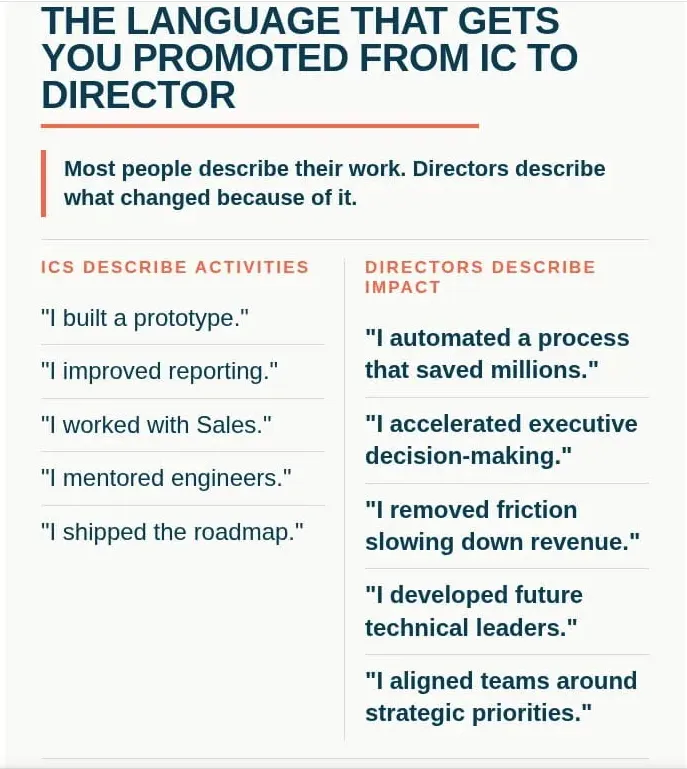
“I defined the roadmap” is an activity. “I aligned the organization around the highest-value opportunities” is an impact.
“I launched a feature” is an activity. “I unlocked a new revenue stream” is an impact.
“I gathered customer feedback” is an activity. “I translated market signals into strategic direction” is an impact.
For Engineering Leaders, the same translation applies:
“I improved system performance” is an activity. “I increased capacity to support business growth” is an impact.
“I reduced incidents” is an activity. “I reduced operational risk across a critical business function” is an impact.
“I led the team through a migration” is an activity. “I enabled the company to scale by modernizing core infrastructure” is an impact.
Different functions. Same pattern: describing the work instead of describing what the work changed.
How to reframe your work at Director level (10 common translations)
These are the phrases Senior PMs and Engineering Leaders use most often, and what they need to become:
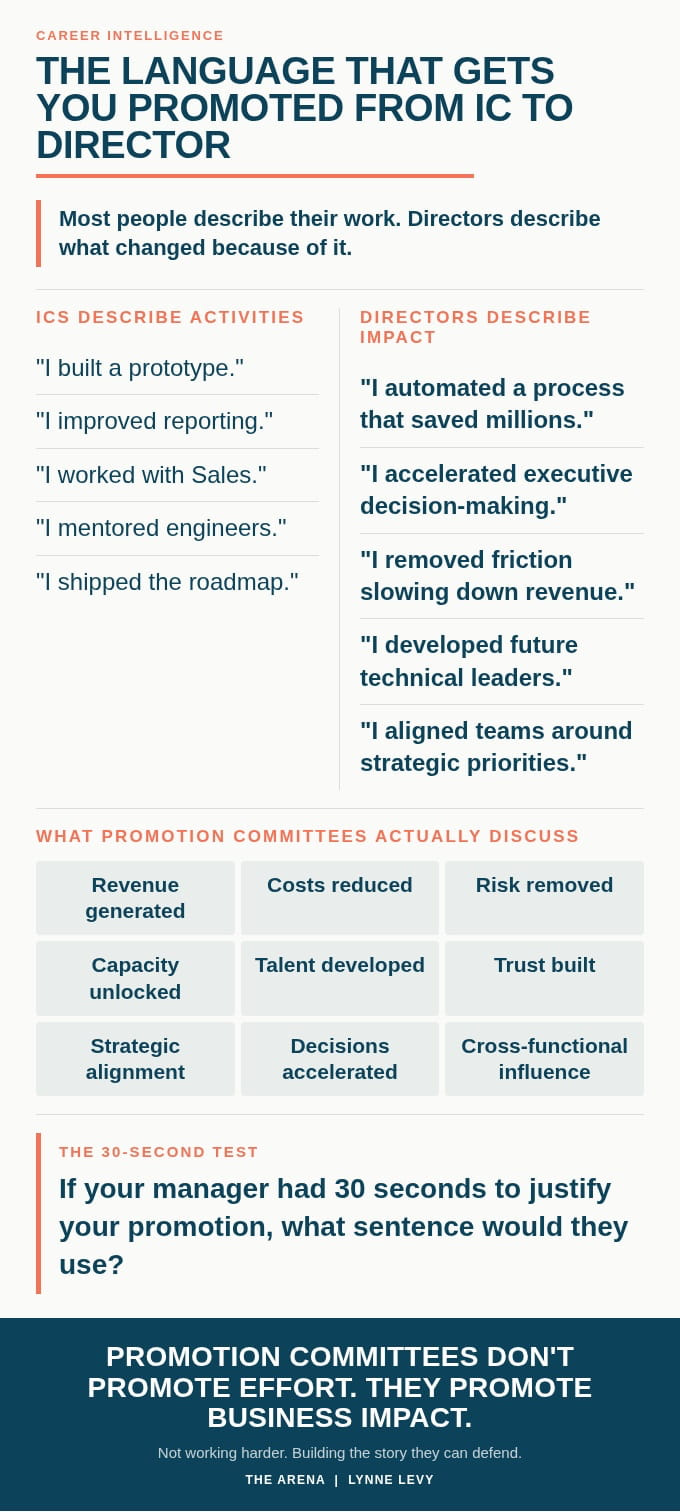
“I led a project” → “I drove a cross-functional initiative that delivered measurable business outcomes.”
“I improved performance” → “I increased efficiency, reducing cost and improving scalability.”
“I handled incidents” → “I built operational resilience and reduced business risk.”
“I supported stakeholders” → “I influenced stakeholders to align on high-impact decisions.”
“I ran meetings” → “I drove alignment to accelerate execution.”
“I analyzed data” → “I generated insights that informed critical decisions.”
“I improved a process” → “I scaled operations by eliminating inefficiencies.”
“I made technical decisions” → “I set direction aligned with long-term business goals.”
“I prioritized the backlog” → “I ensured focus on highest-value opportunities.”
“I helped the team” → “I elevated overall team performance and outcomes.”
The goal is not to dress up what you did. It is to tell the truth at the right level of abstraction: impact, not activity.
The shift most people resist
You are no longer being evaluated on how hard you work.
You are being evaluated on how clearly others can argue for your impact.
Nobody gets promoted because someone says, “They work incredibly hard.”
They get promoted because someone says, “We can’t afford to promote them.”
Same work. Different story. And in a flatter organization, with fewer seats, that story is often the deciding factor.
If your promotion discussion happened tomorrow, what is the one sentence your manager would use to make the case for you?
If you can’t answer that, that is the work.
Key takeaways
Promotion to Director is a selection process, not a reward.The criteria shift completely from what got you here.
Your value currency changes.From what you personally deliver to what changes in the business because of your work.
Fewer seats mean higher stakes.Every Director role filled is one that can’t go elsewhere. The question is no longer “Is this person strong?” It is “Can we defend this at the leadership table?”
The decision happens in a room you’re not in.Your manager has about ten minutes to make your case. Effort carries almost no weight in that room. Impact narrative does.
You can be doing Director-level work and not be perceived as Director-level.Perception is built through narrative, not proximity to the work.
The translation is specific.Activity (”I led a project”) versus impact (”I drove a cross-functional initiative that delivered measurable business outcomes”). Same work. Entirely different defensibility.
Nobody gets promoted because someone says, “They work incredibly hard.”They get promoted because someone says, “We can’t afford to promote them.”
Frequently asked questions about Director-level promotion
Why do high performers not get promoted to Director?
The most common reason: they are still being evaluated on IC-level criteria. Delivering excellent work, meeting deadlines, and being reliable get you to Senior. It does not get you to the Director. At the Director level, the evaluation shifts to business impact, organizational influence, and whether your manager can construct a defensible case for you in a room you are not in. Most high performers have never been told this explicitly. They keep doing more of what worked before, and wonder why it stops working.
What is the difference between IC-level work and Director-level work?
IC-level work is measured by what you personally deliver. Director-level work is measured by what changes in the business because of your work. The output may look identical from the outside. The difference is in how it is framed, communicated, and connected to organizational outcomes. An IC builds a prototype. A Director automates a process that reduces operational cost. Same work. Different story.
What do promotion committees actually look for in Director candidates?
Promotion committees evaluate candidates on business impact, not effort. Specifically, they look for evidence of: revenue generated or protected, costs reduced, risk removed, organizational capacity unlocked, talent developed, strategic alignment driven, and cross-functional influence. They are asking one question: “Is this person operating at a level we can defend promoting?” Effort, tenure, and reliability are assumed at this level. They are not differentiators.
How long does it typically take to get promoted to Director in tech?
Timeline varies by company and role, but the more important variable is not time; it is the readiness signal. Most companies require 12 months of demonstrated Director-level impact before a promotion is approved. The issue for most Senior PMs and Engineering Leaders is not that they haven’t put in enough time. It is that they haven’t translated their work into language the promotion committee can use. Time without a defensible narrative does not accelerate promotion.
What is Director-level impact for a Product Manager?
For Product Managers, Director-level impact means translating business context into strategic direction, not just executing against a roadmap. Examples: aligning the organization around the highest-value opportunities (not just defining the roadmap), unlocking a new revenue stream (not just launching a feature), translating market signals into strategic direction (not just gathering customer feedback). The shift is from managing a product to shaping the business through the product.
What is Director-level impact for an Engineering Leader?
For Engineering Leaders, Director-level impact means connecting technical decisions to business outcomes. Examples: increasing system capacity to support business growth (not just improving performance), reducing operational risk across a critical business function (not just reducing incidents), enabling the company to scale by modernizing core infrastructure (not just leading a migration). The shift is from owning a technical domain to making the business more capable through technical leadership.
Why is it hard to get promoted when your manager supports you?
Manager support is necessary but not sufficient. Your manager has to convince other leaders, not just advocate for you. In most Director-level promotion discussions, your manager presents your case and then defends it under questioning. If your impact story is vague, your manager cannot defend it effectively even with the best intentions. The question is not whether your manager believes in you. It is whether they can make an airtight case in a ten-minute conversation under pressure.