The First 30 Days After a Reorg are Critical
How to Avoid the Biggest Reorganization Pitfalls
TL;DR
Reorgs don’t hurt careers because the work changed. They hurt careers because the story around the work changed. High performers often get sidelined when they assume their reputation, relationships, and priorities automatically transfer to the new organization.
To protect your role, quickly learn the new priorities, build relationships with new decision-makers, and translate your work into the language of the new strategy. Visibility isn’t about self-promotion. It’s about helping leaders understand why your work matters now.
In tech, org charts move faster than most people’s reputations. One quarter you are the safe pair of hands. The next quarter you are “legacy,” “misaligned,” or “not strategic enough” — even if you have not changed a thing in how you work.
Reorgs do not just redraw reporting lines. They reshuffle power, priorities, and who gets credit for what. If you do not adjust how you show up, your reputation will quietly slide while you are busy “keeping your head down.”
This is how to stop that from happening.
Why reorgs hurt your reputation
Reorgs hurt your reputation because they break context.
The people who knew your work, defended your tradeoffs, and understood your product may no longer be the people evaluating you.
In that vacuum, a few things happen very quickly:
Your old wins stop carrying as much weight.
New leaders make snap judgments with limited information.
Other people start telling the story of your role before you do.
The risk is not just change.
It is unmanaged interpretation.
What people get wrong in a reorg
The biggest pattern: acting like the old world still exists.
People keep using the same language, defending the same roadmap, and relying on the same relationships, even after the company has clearly moved on.
They also go quiet.
They think, “I’ll just keep my head down and do good work.”
That sounds disciplined. It often reads as invisible, misaligned, or politically naive.
Common “what not to do” moves:
Assume your reputation transfers automatically.
Keep presenting the old roadmap, with old team names and old OKRs.
Wait weeks before meeting new decision-makers.
Talk only about activity (“we shipped X”) instead of relevance (“here’s why this matters now”).
Let confusion about your role or product sit uncorrected.
Reorgs are risky not because change is bad, but because being passive inside that change is expensive.
What product managers should do in a reorg
If you are a product manager, your job in a reorg is to re-establish alignment, remap stakeholders, and make your product’s role legible in the new story.
You cannot assume anyone else will do that for you.
Product managers: what not to do
Keep running the old roadmap because “it was already agreed.”
Assume the same VP, GM, or committee still owns your priorities.
Stay buried in Jira and avoid strategy conversations because “things are unclear anyway.”
Use outdated language in docs and reviews (old org names, old goals, old bets).
Hope leadership will connect the dots on their own.
All of these create the same impression: this PM is still anchored to the last version of the company.
Product managers: what to do instead
In the first couple of weeks, do the unglamorous, reputation-saving work.
Ask your new manager or leader:
“What are the top three priorities now, and how should my product support them?”Re-map stakeholders:
Who now approves your roadmap, who can block it, and who simply needs to be informed?Rewrite your roadmap in the language of the new strategy:
New pillars, new metrics, new names, new north stars.Add a short “Reorg context” section to your main doc:
What changed, what stayed the same, and what you are proposing to adjust.Share concise updates (email, Slack, or Loom) that answer:
“Here is what my product owns, here is how it supports the new priorities, and here are the tradeoffs I recommend.”
A simple script you can reuse:
“Here is what my product owns.”
“Here is how it supports the new direction.”
“Here is what I think we should stop, start, and double down on.”
You are not bragging.
You are making your work legible to people who do not have your history.
What engineering leads should do in a reorg
If you are an engineering lead, your job in a reorg is to connect technical work to the new business reality, align early with adjacent teams, and make risks and tradeoffs easy for new leaders to understand.
You are not just protecting delivery. You are helping the new org trust that your team is pointed at the right problems.
Engineering leads: what not to do
Treat the reorg like paperwork and keep all your rituals and priorities unchanged.
Protect the old backlog because “we promised this” without rechecking if it still matters.
Ignore new platform or cross-team forums because they feel political or “not real work.”
Talk only in technical detail when leadership is asking about impact and risk.
Frame everything as “our service / our component” instead of fitting it into the bigger platform or journey.
This is how technically strong teams end up being seen as “off on their own island.”
Engineering leads: what to do instead
Use the reorg as a forcing function to tighten your story.
Meet your new leader with a one-page summary:
Key systems you own, current health, and how they support the new goals.Reprioritize explicitly:
Tie backlog items to what now matters most — reliability, cost, growth, security, or whatever the new theme is.Join or help create shared design / architecture forums with neighboring teams:
Aim for one coherent technical story, not three overlapping ones.Update your team’s rituals (standups, planning, reviews) to keep reinforcing:
“Here is how our work connects to the new outcomes.”When you present up, lead with impact and risk:
“Here is what our work unlocks, here is what breaks if we do not invest, and here is what I recommend we stop doing.”
A simple script you can lean on:
“Here is what we own.”
“Here is how it supports the new direction.”
“Here are the risks if we underinvest.”
“Here is what I recommend we cut to make room.”
You want to be the calm person who shows up with a clear picture and a plan, not the person clinging to old commitments no one else remembers.
What to do in the first 30 days after a reorg
The first 30 days after a reorg are when opinions about you solidify.
People are watching:
Who adapts quickly.
Who stays stuck in the old framework.
Who disappears into the work without ever reframing it.
Use those first 30 days deliberately.
30-day checklist
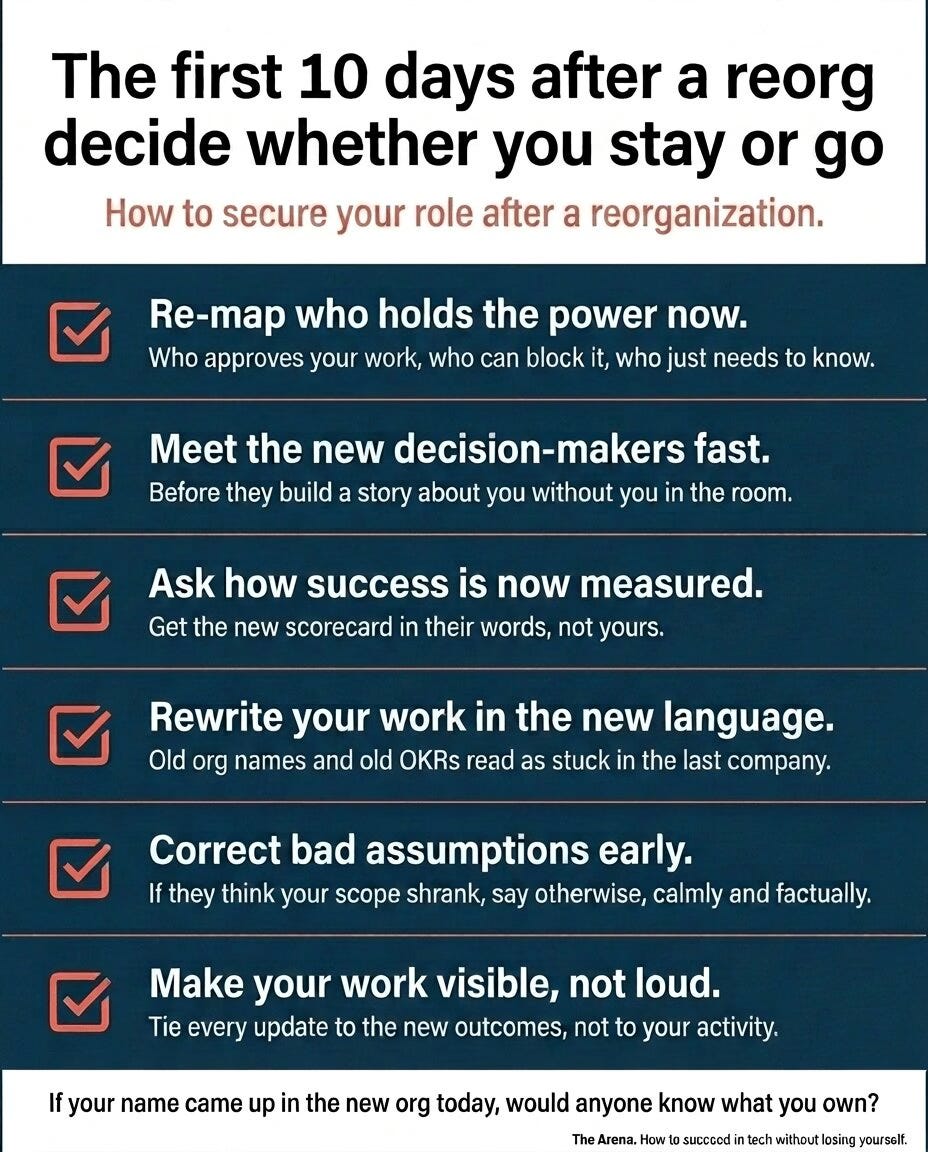
Meet the new decision-makers.
Short, focused, and respectful of their time. “Here is what I own. How can I be most useful to you in this new setup?”Clarify how success is now measured.
Ask directly. “What will you be looking at to judge if this area is doing well?”Rework your language.
Update your docs, decks, and status updates to match the new strategy wording. Use their words, not just yours.Correct bad assumptions early.
If people think your product is sunsetting, or your team’s scope has shrunk, clear it up calmly and factually.Make your work visible, not loud.
Regular, short updates that tie your work to outcomes. Not “look at me,” but “here is how this piece of the puzzle is moving.”
If you do nothing else, do this: stop assuming people understand your value.
Spell it out, clearly and calmly.
Quick Takeaways
Meet new decision-makers early.
Clarify how success is now measured.
Update your language to match the new strategy.
Correct bad assumptions before they spread.
Make your work visible through business impact, not activity updates.
You can be doing great work and still look “off” after a reorg.
Not because you got worse overnight.
Because the game changed and no one told you the new rules.
FAQ
How do reorgs hurt high performers?
Reorgs hurt high performers when their value was tied to old sponsors, old goals, or old definitions of success. If the company changes what it values and you do not change how you frame your work, you can quietly age out of the story even while doing strong work.
Should you keep your head down during a reorg?
No. “Keeping your head down” often looks like disappearing.
You can stay measured and non-dramatic and still be visible, aligned, and present in the rooms where new decisions are being made.
What matters more in a reorg: performance or visibility?
You need both, but visibility becomes critical when leaders lack context.
They cannot interpret your performance if they do not know what you own, how it connects to their goals, or why it should stay funded.
What is the single biggest mistake PMs and engineering leads make?
The single biggest mistake is staying loyal to the last version of the org for too long.
The faster you translate your work into the new story, the safer — and more promotable — your reputation becomes.
When the org chart keeps shifting, it is tempting to tell yourself, “I’ll just wait for things to settle.”
They rarely do.
The people who come out of reorgs with more leverage are not the ones who stay the most loyal to the old world. They are the ones who:
Learn the new rules quickly.
Make their work easy to understand in the new story.
Keep showing up as calm, clear, and useful in rooms that feel chaotic.
That is not about playing politics for its own sake.
It is about owning the one thing you can actually control when everything else is moving: how legible, aligned, and steady you look to the people now deciding your future.
Reorgs are not going away.
But getting quietly sidelined in them does not have to be your story.
Lynne Levy is an executive coach for senior product and tech leaders. She publishes The Arena of Work atthearenaofwork.substack.com. Book a call at l